The 100-Inch Home Cinema Room Checklist: Will Your Room Actually Fit One?
Throw distance, seating distance, ceiling height and light control — a practical checklist to confirm your UK room can host a 100-inch projector picture.
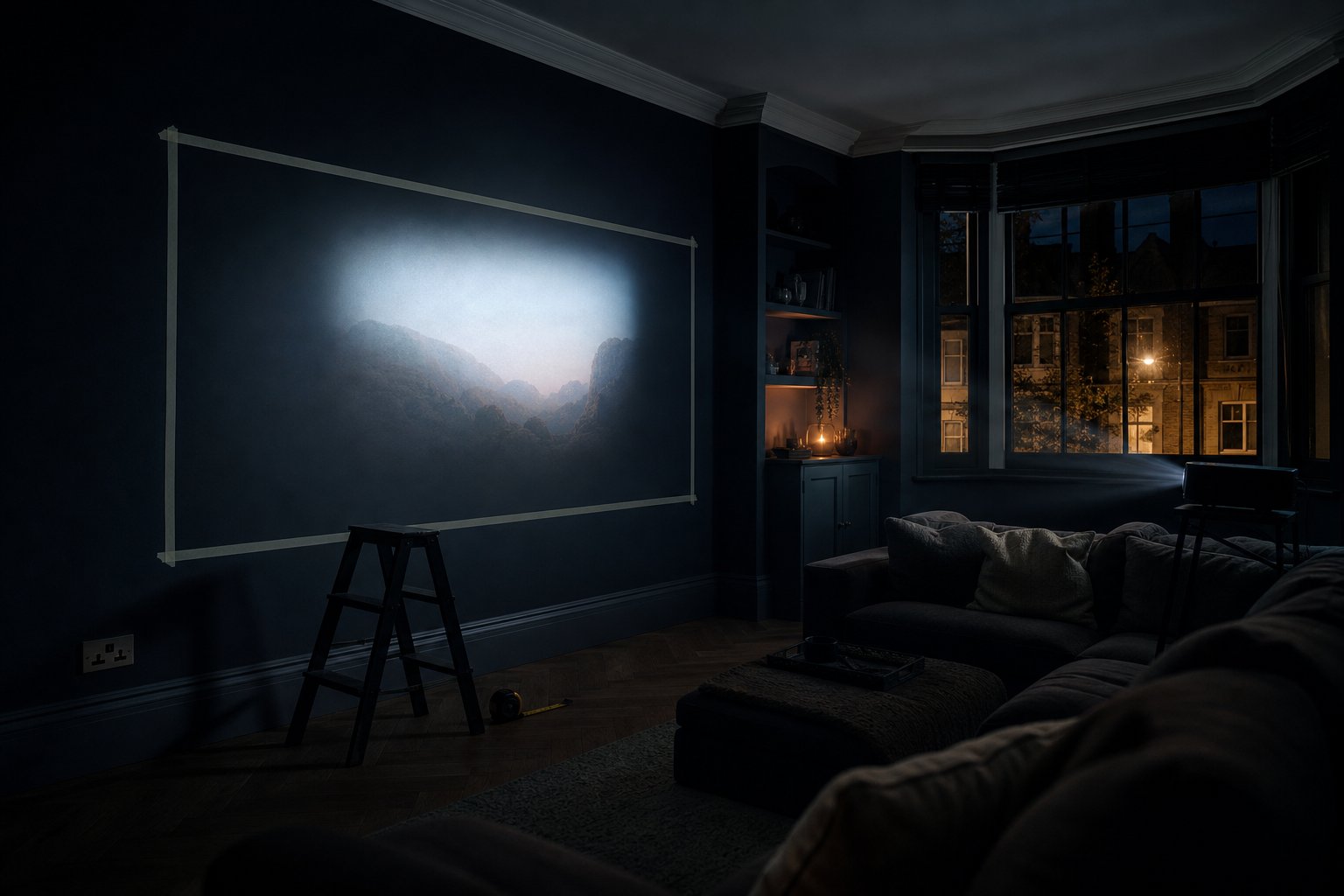
A 100-inch projected picture needs a wall patch about 2.21 m wide by 1.25 m tall, a projector positioned roughly 2.6–3.1 m from that wall (for a standard-throw machine like ours), and seating between 2.7 m and 4.2 m away. Most UK living rooms and many bedrooms pass those tests — but check all five items below before you buy anything.
Measure once with a tape measure now, or measure twice with a returns label later. Every number below comes from standard projection geometry — the same maths used by professional AV planning tools — applied to typical UK rooms. If you would rather type than measure, our home cinema planner runs this whole checklist interactively and tells you the largest honest picture your room supports.
Check 1: the wall — 2.21 m of clear, flat surface
A 100-inch 16:9 image measures 2.21 m wide × 1.25 m high (diagonal × 0.872 and × 0.490 respectively — trigonometry, not opinion). Add a hand’s width of margin all round and you need roughly 2.4 m of uninterrupted wall: no radiator pipes, no light switches, no picture rails through the middle.
Height matters too. With UK ceilings commonly at 2.4 m, centring a 1.25 m image leaves about 57 cm above and below. That works — but if you plan to mount the projector high or sit it on low furniture, remember keystone correction can square the picture yet always costs sharpness (it crops and rescales the panel digitally). The honest advice printed in every calibration guide applies: position the projector physically square-on first, use digital correction last. Our machine offers auto-focus and ±30° auto keystone for convenience, but the best picture is always the one that needed neither.
Surface quality is the quiet variable — matte white emulsion works surprisingly well, gloss paint and textured wallpaper do not. We quantified the difference in our screen vs white wall test.
Check 2: throw distance — where the projector must stand
Every projector has a throw ratio: distance to the wall divided by image width. Standard-throw home machines cluster around 1.2–1.4:1. The Beamora Ultra projects 50 inches from 1.54 m and scales to its maximum at 8.43 m (spec sheet); that geometry implies, for common sizes:
| Image size | Image width | Approx. throw distance |
|---|---|---|
| 80” | 1.77 m | ~2.1–2.5 m |
| 100” | 2.21 m | ~2.6–3.1 m |
| 120” | 2.66 m | ~3.2–3.7 m |
Those distances derive from the published placement range rather than a bench-measured throw table, so treat them as planning bands with a little slack either side — and confirm against your own tape measure before you drill.
Practical placements that satisfy 2.6–3.1 m in real rooms: a shelf or sideboard behind the sofa, a rear-wall bracket, or a ceiling mount just behind the seating line. Two things people forget: the projector needs a power socket within cable reach at that position, and it should sit roughly level with the top or bottom edge of the intended picture unless you enjoy keystone compromises (see Check 1).
If your room simply cannot give you 2.6 m of throw, the choices are a smaller image (an 80-inch picture still humiliates any TV you have owned) or a short-throw machine — a different product category at a different price. We would rather tell you that here than after checkout.
Check 3: seating distance — the cinema-industry window
Two industry standards bracket the comfortable range. SMPTE’s 30° viewing angle gives a relaxed cinema feel at about 1.6× the image width; THX’s 36° recommendation is more immersive at about 1.2× width. For a 100-inch picture (2.21 m wide) that means sitting 2.7 m to 3.6 m away, stretching to ~4.2 m before the image starts feeling like a large TV rather than a cinema.
Handy corollary: in most UK lounges the sofa already sits 2.5–3.5 m from the far wall. The 100-inch cinema was hiding in your room all along; it just needed the furniture audit.
At those distances, native 1080p resolution sits at or beyond visual acuity limits — you will not count pixels. (The full argument, including when 4K genuinely earns its premium, lives in our honest resolution guide.)
Check 4: light control — the one test rooms fail
Everything above is geometry; this is physics. A 1,200 ANSI lumen machine — ours, or anything honest in the sub-£500 class — delivers a vivid 100-inch image in a darkened room and a washed-out one against open daylight. The checklist question is simple: can this room reach curtains-drawn darkness at your usual viewing time?
Living room with decent curtains, evening viewing: pass. Bedroom with a blackout blind: pass, easily. South-facing conservatory for Saturday lunchtime football: fail at any price under about £1,500 — see our ANSI brightness guide for the numbers behind that.
Check 5: the boring essentials
Thirty seconds each, but each has ruined a movie night: a power socket within ~1.5 m of the projector position (extension leads across walking routes end badly); ventilation clearance of ~15 cm around the unit — projectors move air, and smothering one on a cushion shortens its life; fan noise tolerance if the unit sits close to your head — we prefer a measured decibel figure on the test report to adjectives, so treat “quiet” claims from any brand as unverified until a number with a method appears; and WiFi reach at the projector position for a streaming machine (5 GHz preferred — our unit carries dual-band 5G WiFi and Bluetooth 5.2 for external speakers).
Scorecard
Five checks: a 2.4 m clear wall, 2.6–3.1 m of throw, seating at 2.7–4.2 m, achievable darkness, and sockets/airflow/quiet. Pass all five and your room is 100-inch ready — the Beamora Ultra will fill that wall for £332. Pass four and the fix is usually curtains or moving a shelf. Unsure about the arithmetic? Let the planner do it: enter your room’s length, width and light situation and it returns your maximum honest image size, throw position and a straight yes/no on brightness fit.