4K Projector Buying Guide for UK Homes

Summer Daylight vs Your Projector: The Honest Guide to Bright-Room Viewing
London stays light past 9pm in June. When drawn curtains rescue a projector, when an ALR screen earns its cost, and when the honest answer is the TV.
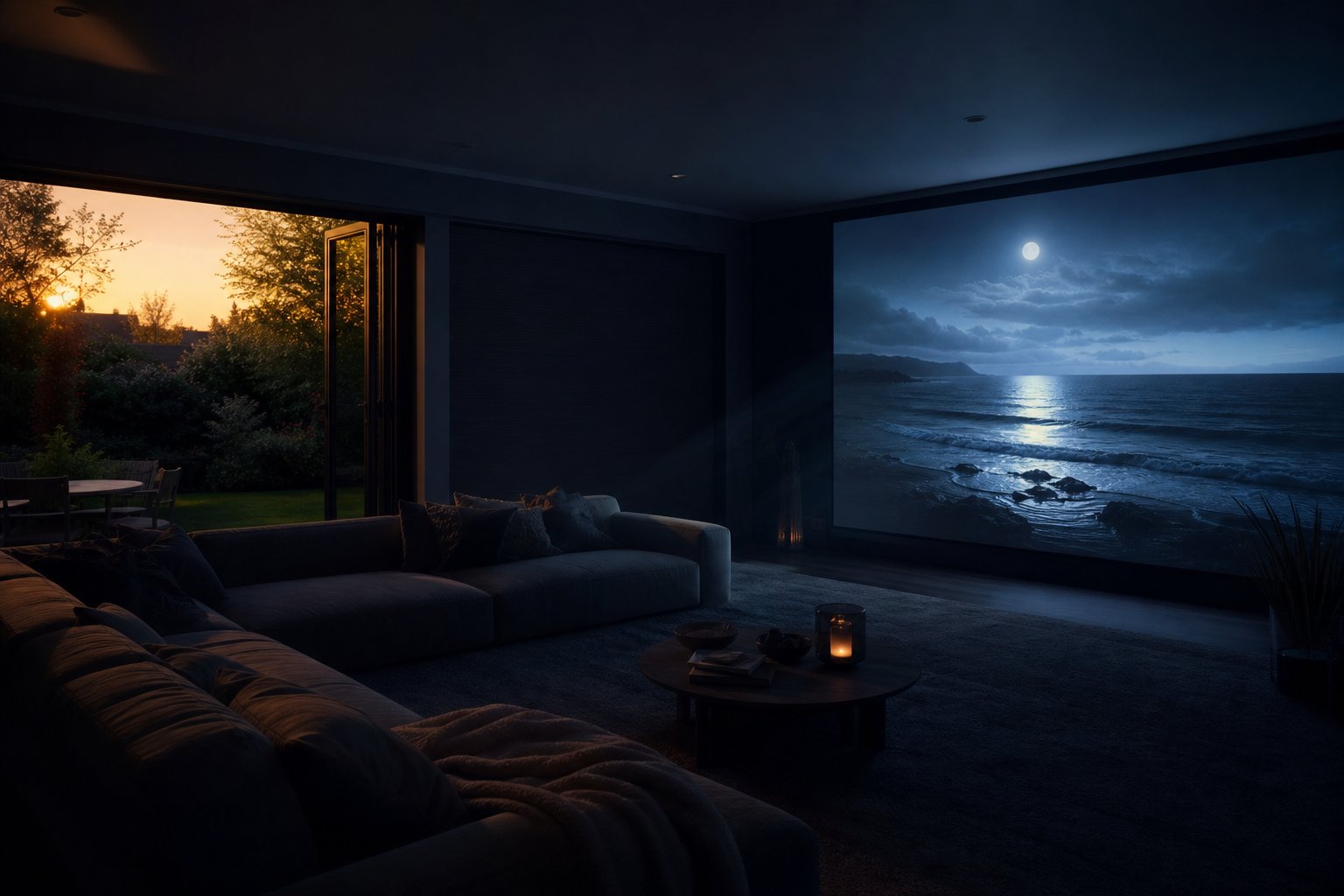
A projector that looked superb in December can look washed out in June, and the machine has not changed — the light has. This guide is the honest decision ladder for British summer viewing: when drawn curtains solve the problem, when an ambient-light-rejecting screen earns its price, and when the right answer is simply the television.
The physics: June light is measured in thousands of lux
Start with the numbers nobody prints on a box. In London the sun sets around 8pm by mid-April, around a quarter to nine by mid-May, and not until roughly 9:20pm at the June solstice — with usable twilight hanging around for another forty minutes after that. Edinburgh keeps its light later still. (All times approximate; they vary by UK location. Source: standard astronomical tables.)
Meanwhile, the projected picture has a fixed brightness allowance. The Beamora Ultra is rated at 1,200 ANSI lumens — a figure we back with bench measurements on our test report page rather than adjectives — and at 100 inches that output is spread across nearly three square metres of wall. An uncovered window on a bright afternoon pours light onto that same wall at levels measured in the thousands of lux. The projector cannot win that contest, and neither can any of its rivals at this price. We are measuring how the picture behaves across three different surfaces — screen, matte white wall, coloured wall, at a fixed 100-inch image — precisely so we can talk about this with data instead of hope; those readings publish on the test-report page with method and date, and until they do we quote none.
We wrote up what our winter afternoon lux measurements showed when the problem was an overcast 3pm in January. Summer is the same physics with the difficulty turned up: more light, arriving for more hours, at a shallower and more annoying angle.
Rung one: darken the room — the fix that solves most cases
Before spending on hardware, spend on fabric. Lined curtains drawn at 8pm recover more picture quality than any setting, mode or upgrade, because they attack the problem at its source. Clip-in blackout linings for an average window cost less than a takeaway for four, install in minutes, and turn a bright June evening into a workable viewing room. Our blackout guide for living rooms walks through linings, blinds and films by cost and effectiveness.
Two multipliers make rung one work harder. First, shrink the image: dropping from 120 to 100 inches concentrates the same light into a smaller area and lifts brightness per square metre by roughly 44%. A smaller, saturated picture beats a big grey one every single time. Second, use the picture mode that delivers full output — aggressive eco modes can cost you a large slice of rated brightness exactly when you have none to spare. The room planner will tell you the largest honest image your room supports in each light condition, including the answer you might not want.
One structural caveat: rooms with wall-sized glazing — bi-fold doors, roof lanterns — are a special case where curtains alone may not be practical. We cover those in a dedicated light-control guide for modern UK living rooms.
Rung two: the ALR screen — what it fixes, and what it cannot
Ambient-light-rejecting screens are the most misunderstood purchase in this category, so here is the honest version. An ALR screen uses optical structures or angular coatings to reflect the projector’s light towards your seat while rejecting light arriving from other directions. Against moderate, indirect ambient light — a lamp, a doorway, residual dusk — a good one visibly deepens contrast and rescues colour.
What it cannot do is repeal physics. Direct sunlight falling on the screen face overwhelms any coating; an ALR surface delays defeat, it does not prevent it. And there is a compatibility trap worth knowing before you spend: lenticular “sawtooth” ALR screens are engineered for ultra-short-throw machines sitting directly beneath the picture, and they perform poorly with a standard-throw projector like ours. A standard-throw room needs the angular-reflective type designed for light arriving from across the room. Check the specification line, not just the letters A-L-R.
On cost, ALR material commands a serious premium over plain matte white — typically several times the price at the same size — and prices move constantly, so we will not print a number that goes stale — check two or three current UK retailer listings for 100-inch angular-reflective fixed frames on the day you decide. Our verdict rule: an ALR screen is worth considering when you watch regularly in genuine daylight, you cannot or will not darken the room, and the projector position is fixed. For an evenings-first household, rung one plus patience is better value.
Rung three: know when to switch the television on
Here is the stance you will not find on most projector sites, and the one our own room planner is programmed to give: for curtains-open daytime viewing, no compact projector at this price stays vivid — ours included — and the honest tool for that job is a television. If your household’s summer viewing is Saturday lunchtime sport in a bright room with the curtains open and the doors ajar, a mid-sized TV will serve that hour better than any 1,200-ANSI machine, and we would rather say so before you pay than after. The full arithmetic of running both technologies side by side lives in our projector versus 65-inch TV cost comparison.
Losing that hour does not lose the argument. The projector’s case was never noon in July; it is the other nine months, and every summer evening after the light goes.
The summer owner’s playbook
What we actually do between April and August, in one honest list. Start films at sunset, not at eight: by late June that means a 9:30pm curtain-up, which suits one feature better than a double bill. Give sport the drawn-curtains treatment — bright pitch-and-crowd coverage holds up against modest ambient light far better than a moody thriller does, because dark scenes are always the first casualty of stray light (the numbers behind that are in our ANSI lumens guide). Shift the marathon sessions to weekends. And remember the season turns: from September the sunsets sprint back towards 7pm, and the machine that felt compromised in June feels like a cinema again.
The bottom line
Work the ladder in order: fabric first, ALR only for genuine daytime habits with a fixed setup, television for the bright-room hours a projector was never going to own. That is the whole truth about summer, stated by people selling the projector — because a buyer who knows exactly what June looks like is a buyer who is still happy in December.
Ready to transform your home with Beamora?
Upgrade My Home Cinema — £332.22