4K Projector Buying Guide for UK Homes
The Serious Buyer's Guide to Projectors Under £500 in the UK (2026)
An honest, spec-by-spec framework for choosing a projector under £500 in the UK — what the numbers mean, where brands cut corners, and what to check.
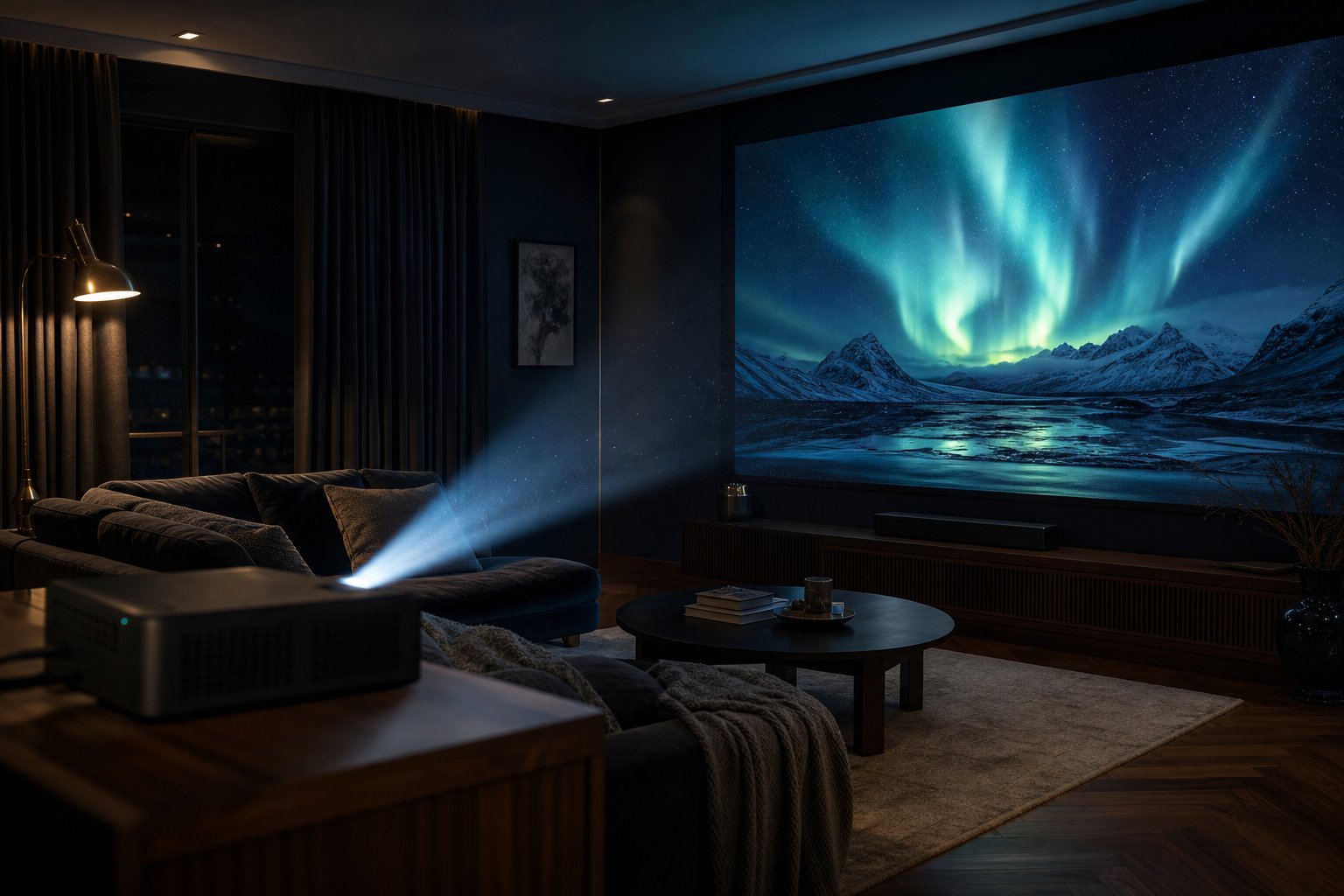
Choosing a projector under £500 in the UK comes down to five checks: real (not marketing) brightness of 1,000+ ANSI lumens for evening viewing, native 1080p resolution, licensed streaming apps, a LED light source rather than a lamp, and a returns policy you can actually use. This guide walks through each check with the numbers that matter.
A quick note on who is writing this: we are Beamora, and we sell one of the projectors in this price bracket. Rather than pretend to be a neutral top-ten list, this is the checklist we wish every buyer used — including on our own product page. Where we reference our own hardware, we say so plainly, and where a rival does something better, we say that too.
Why the £300–£500 bracket is different
Below £200, you are buying a casual gadget: fine for a ceiling film night, forgiven when the speaker rattles. Above £800, you are in enthusiast territory — XGIMI Horizon at £469–£789, Anker’s Nebula Cosmos line at £949+, native 4K machines beyond that.
The £300–£500 bracket is where things get serious but budgets stay sane. You should expect genuine home-cinema performance: a sharp native 1080p image at 100 inches, sound you can live with, and a smart system that streams without a drawer full of dongles. You should also expect marketing departments to work hardest here, because this is where shoppers compare hardest. Reddit’s projector communities are full of buyers asking whether a £300 listing is “too good to be true” — a fair question, and one this guide is designed to answer with evidence rather than vibes.
Check 1: brightness — demand ANSI, and treat big numbers with suspicion
Brightness is the most abused spec in this category. Some listings quote “lumens” with no standard, some quote light-source lumens (the raw output of the LED, not what reaches the screen), and a few quote honest ANSI or ISO figures. As one experienced Redditor put it after two summers of garden screenings: what matters is “actual tested ANSI… not marketing lumens”.
The working rules for UK homes:
| Viewing situation | Realistic ANSI needed |
|---|---|
| Blackout / evening, curtains drawn | 1,000–1,500 |
| Living room, some lamp light | 1,500–2,500 |
| Daylight, curtains open | 3,000+ |
At this price, no compact smart projector genuinely handles bright daylight — anyone claiming otherwise is selling you disappointment. Our own Beamora Ultra is rated at 1,200 ANSI lumens, which is an evenings-and-drawn-curtains machine, and our product page positions it exactly that way. We are commissioning independent-style bench measurements — nine-point ANSI in standard and eco modes, plus centre lux at 80, 100 and 120 inches — and the readings go up on our test-report page with the method beside them; until they do, the rated figure is the only number we will print.
If you want the full maths, including how screen size dilutes brightness, read our ANSI lumens guide.
Check 2: resolution — “native 1080p” beats “4K-branded”
Under £500, every “4K” badge you see means 4K input support, not 4K pixels on the wall. That includes ours. The chip that actually forms the image is 1080p; a good one accepts a 4K signal and downscales it cleanly. This is not a scandal — it is how the whole bracket works — but brands that bury it in a footnote are telling you something about their honesty elsewhere.
What to verify: the phrase native 1080p (1920×1080) in the spec table, not “supports 1080p” (which can mean a 720p or even 480p chip upscaling). At typical UK viewing distances — around 3 metres from a 100-inch image — a clean native 1080p picture is sharp enough that resolution stops being the weak link; brightness and optics matter more. We wrote a plain-English explainer on exactly what 4K decoding does and does not mean.
Check 3: streaming — licensed apps or a lifetime of workarounds
Here is the dirty secret of Android projectors: Netflix requires per-device certification, and most projectors do not have it. XGIMI’s own Amazon listing for the Horizon states the product “does not stream the native Netflix app” — on a £469+ machine, you are expected to add a Fire TV stick. Workaround launchers exist; they break, they fight the remote, and they cap picture quality.
Ask the seller directly: is Netflix officially licensed on this device? On the Beamora Ultra it is — Netflix, YouTube and Prime Video run natively on the Android 12 system, no stick required. That licence is part of what you are paying for when a no-name-brand price looks “too high” next to an AliExpress clone; certification costs real money and cheap clones simply skip it.
Check 4: light source — LED lifespan versus lamp running costs
Epson’s entry 3LCD machines (CO-FH02, £479–£680 street) are the traditional safe choice in this bracket, and their colour brightness is genuinely good. But they use a 188 W UHE lamp rated at 6,000–12,000 hours — a consumable you will eventually replace, in a form factor the enthusiast community increasingly recommends against; “don’t buy a lamp-based projector any more” is now a common refrain in r/projectors threads.
An LED light source — used by us, XGIMI, and most of the smart-projector generation — is rated for roughly 30,000 hours, runs cooler and cheaper, and never needs a bulb swap. Over five years of nightly films, that difference is not cosmetic; we lay out the full running-cost table in our projector vs 65-inch TV cost comparison.
Check 5: the seller — warranty behaviour beats warranty length
The £300–£500 bracket is full of brands you have not heard of, including, frankly, us. UK buyers on r/budgetprojectors report that what separates a good unknown brand from a bad one is not the warranty PDF but what happens when something fails: one buyer whose £160 unit developed a screen blemish at ten months had a replacement shipped promptly — “I would say it’s worth it” was the verdict.
So check three things before paying: a UK returns window of at least 30 days with a stated process; a warranty with a named duration and a real support address; and dispatch/delivery promises that match the courier reality (ours are 1–3 working days to dispatch, 2–4 days in transit — stated plainly, no ticking clocks). We keep all of this on one page — our buy-with-confidence guarantee — because at this price you deserve it in writing, not scattered across footers.
The shortlist test, applied
Run any candidate through the five checks. As a worked example, here is how the obvious UK options score as of July 2026:
| Machine (street price) | Native res | Brightness (rated) | Licensed Netflix | Light source |
|---|---|---|---|---|
| Beamora Ultra (£332) | 1080p | 1,200 ANSI | Yes, built in | LED |
| XGIMI Horizon FHD (£469–£789) | 1080p | 1,500 ISO | No — needs stick | LED |
| Epson CO-FH02 (£479–£680) | 1080p | 3,000 lm (3LCD) | Yes (Android TV) | 188 W lamp |
Three honest conclusions fall out. If you need daylight brightness above all and accept lamp replacement, the Epson case is real. If money is no object and you want XGIMI’s design polish, pay the premium and budget for a streaming stick. If you want licensed streaming, LED longevity and native 1080p at the lowest serious price, that is exactly the gap we built the Beamora Ultra to fill — and our side-by-side with the XGIMI Horizon shows the line-by-line detail so you can judge, not take our word.
Whatever you choose, buy from someone who publishes their numbers, names their warranty, and answers the awkward questions before you ask.
Ready to transform your home with Beamora?
Upgrade My Home Cinema — £332.22