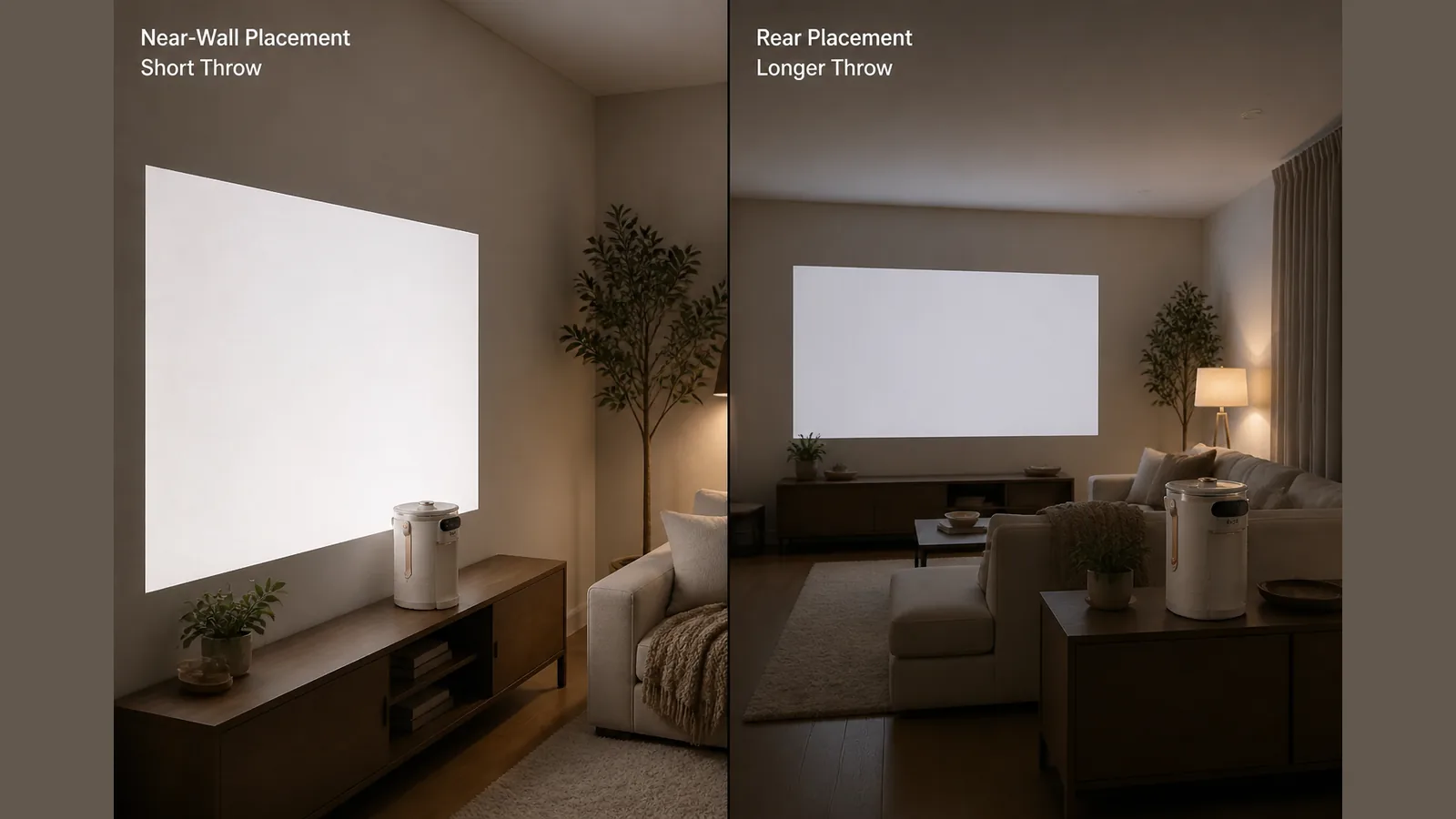
Short throw vs long throw projector UK living room
Direct answer: measure usable depth first
For a short throw vs long throw projector UK living room decision, measure usable depth from the wall or screen to where a projector can sit—before you compare brightness claims or smart features. Throw type is mainly a room-geometry choice: short throw needs less depth for a given image size, while long or standard throw needs more space behind the seating area.
Throw ratio in plain UK English with a simple table
Throw ratio links how far the projector sits from the screen to the width of the image. A lower ratio means the same picture size from a shorter distance; a higher ratio means you need more depth. That is why short throw is often discussed for tighter flats, while longer throw suits deeper rooms with a clear path behind the sofa.
| Throw type | Typical placement idea | Room-depth implication |
|---|---|---|
| Ultra-short throw (UST) | Very close to the wall or screen, often on a low cabinet | Works when you have almost no free depth, but needs a clear strip in front of the wall |
| Short throw | Closer to the wall than a standard living-room throw | Useful where depth is limited but you still have some stand or shelf space |
| Standard / long throw | Further back, often near or behind seating, or ceiling-mounted | Cleaner when the room is deep enough and walkways stay clear |
UK living-room depth often decides whether short, standard or ultra-short throw is realistic at all. Table or stand placement can suit rentals and temporary setups when you cannot drill a ceiling mount.
When short throw helps terraced rooms and when long/standard throw is cleaner
Short throw helps many terraced and flat living rooms where the sofa sits close to the opposite wall and you cannot push a projector far back. If you can only free a modest shelf or sideboard distance from the screen, short throw is usually the practical path—provided the throw ratio and your measured depth still match the picture size you want.
Long or standard throw is often cleaner when you already have depth: a hallway spill into an open-plan room, a bay that lets you mount further back, or a dedicated seating row with space behind it. In those rooms, placing the unit further away can keep the front of the room free of cabinets, reduce people walking through the beam, and leave cable runs tidier along skirting or ceiling routes.
- Choose short throw when measured depth is tight and you still want a large image.
- Choose standard or long throw when depth is comfortable and you prefer the projector out of the main walkway.
- Treat UST as a separate decision: it needs almost no throw distance, but it changes furniture and screen placement rules.
Shadows, cable runs and who should not buy UST
Anyone walking between a short-throw unit and the wall can cast shadows; the closer the projector, the more often that happens in busy family rooms. Cable runs matter too: a unit on a front cabinet needs power and HDMI or streaming leads near the screen wall, while a rear or ceiling position may need longer runs but keeps the viewing zone clearer.
Ultra-short throw is a poor fit if you cannot keep a low, stable surface hard against the wall, if children or pets constantly cross that strip, or if your wall finish and screen alignment will not tolerate a near-wall optic. If you rent and cannot control furniture layout week to week, a short or standard throw on a moveable stand is often simpler than committing to UST placement.
Next step after the decision path
Once you know your usable depth, preferred picture size and whether people will walk through the beam, compare live product pages for throw-distance guidance rather than assuming any model is short throw or UST. Check the current product details against your tape measure before you buy, and confirm throw ratio and placement notes on the page itself.
FAQ
What should I measure first in a UK living room?
Measure the clear depth from the wall or screen plane to the furthest practical projector position—shelf, cabinet, sofa back or ceiling line—then match that to throw ratio and image width, not marketing labels alone.
Is short throw always better for flats?
No. Short throw helps when depth is limited, but a deeper flat with a clear rear path may be happier with standard or long throw and fewer front-of-room cables or shadows.
How is ultra-short throw different from short throw?
UST sits much closer to the wall than short throw and usually needs a dedicated near-wall surface and careful alignment; short throw still needs some depth, just less than long throw for the same image size.
Can I decide from brightness or “4K” labels alone?
No. Brightness wording, resolution, HDR and app or platform details should be verified on the live product page; they do not replace a throw-distance check for your room.